

A Hero's Journey from Gokwe to National Heroes Acre
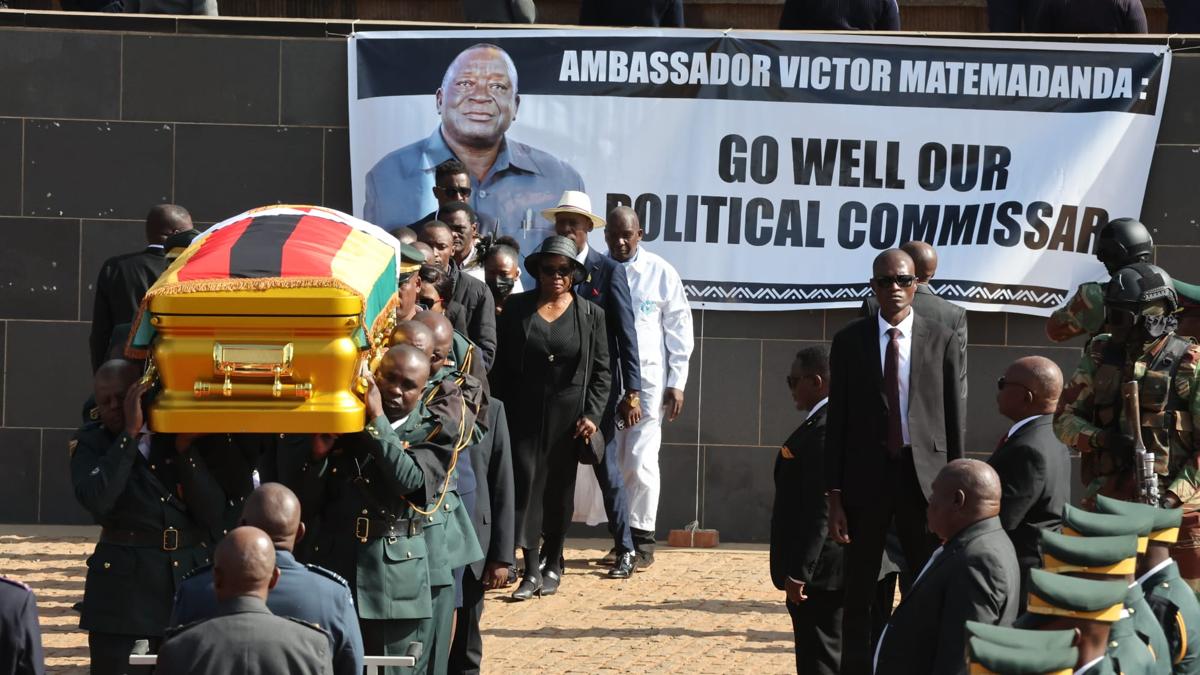
The sun hung heavy over the granite slopes of National Heroes Acre this Friday morning, casting long shadows across the solemn gathering of dignitaries, veterans, and grieving family members. At the heart of this hallowed ground, President Emmerson Mnangagwa stood with bowed head, presiding over the interment of a man whose life had been etched into the very fabric of Zimbabwe's liberation story Ambassador Victor Matemadanda, the gallant son of Gokwe who had traded his youth for the promise of a free nation.
Just five days earlier, on June 20, 2026, the 66-year-old veteran had drawn his final breath at Parirenyatwa Group of Hospitals in Harare, his battle against a short illness ending quietly in the same city where he had once prepared for war. But for those who knew him, Victor Matemadanda had been fighting since the moment he was born into a world that had drawn borders around his people's dreams.
The Making of a Revolutionary
In the dusty village of Kampaundi, near Empress Mine in Gokwe, Midlands Province, Maria Matemadanda (nee Kanga) had no way of knowing that her last-born child would one day stand shoulder-to-shoulder with presidents and represent his nation on foreign soil. Young Victor entered the world on March 3, 1960, joining a bustling household of seven siblings—Patrick, Fidelis, Remigio, Ottilia, Patricia, Christine, and Teresa—all of whom would watch their youngest brother transform from a village boy into a national icon. Follow us on WhatsApp
But the rhythms of rural life in Gokwe were shattered when the heavy hand of colonial land policies came crashing down on the Matemadanda family. Like countless other African households, they were forcibly uprooted from their ancestral lands, dispossessed of their heritage and livelihoods by a regime that viewed black prosperity as a threat to its carefully constructed hierarchy. The family joined the exodus of Zimbabwean migrants seeking refuge in Zambia, carrying little more than their dignity and their determination to survive.
It was in Zambia that young Victor's education began—first at Nambala Primary School in Mumbwa, then at Mumbwa Secondary School. But the classroom could not contain the fire that had been kindled in his heart. By the time he was a teenager, the liberation struggle was calling, and Victor Matemadanda answered with the courage of a man twice his age.
The Comrade Emerges
In late 1978, the young revolutionary was sent to Mozambique for military training at Tembwe Camp, where he came under the instruction of seasoned commanders Edwin Munyaradzi Zvakaoma, Ngwarai Mashizha Kandawasvika, and Dzingai Mabhunu. They recognized something special in the young recruit—a quiet intensity, an unshakeable commitment to the cause, and a natural ability to inspire those around him.
Upon completing his training, Cde Matemadanda—now known by his chimurenga name, Cde Hama Yesango—was deployed to the operational front in Zimbabwe under Takawira Sector, Detachment A. There, he served under the command of Cde Hillary Mudhuri, whose own nom de guerre, Advance Tsigira Hondo, had already become legendary among the liberation forces.
The operations were brutal and dangerous, each mission designed to weaken the colonial regime's grip on power. In August 1979, during one particularly fierce engagement, Cde Matemadanda sustained injuries that would have broken lesser men. But as he was evacuated to Mozambique for medical treatment, he carried with him not bitterness, but a renewed determination to see the struggle through to its conclusion.
From Battlefield to Assembly Point
When the ceasefire came in 1980, the young freedom fighter joined his comrades at Dendera Assembly Point, their weapons laid aside but their spirits still burning with revolutionary fervor. Recognizing his stewardship capabilities, the leadership appointed him as one of the Political Commissars tasked with educating and mobilizing communities in former war zones about the electoral process ahead of Zimbabwe's first general elections.
On November 27, 1980, Cde Matemadanda formally joined the Zimbabwe National Army, but his military career would be marked not by further combat, but by an extraordinary commitment to self-improvement. Having sacrificed his formal education to join the liberation struggle, he resumed his studies through the Rapid Results College Correspondence Programme, completing his Forms One and Two. Between 1983 and 1984, he pursued Ordinary Level studies through a study group at Warren Park High School in Harare. By 1985, he had enrolled at Central African Correspondence College, undertaking Advanced Level studies.
The soldier had become a scholar.
The Warrior's New Battle
In 1986, after a decade of service, Cde Matemadanda retired from military service to devote himself fully to advancing the interests and programs of the ruling party, ZANU-PF, and championing the welfare of former liberation fighters. His experience as a liberation war veteran and his deep understanding of Zimbabwe's history made him an influential voice within the War Veterans Association.
By 2004, he had been appointed National Secretary for Historical and Cultural Affairs, a position that allowed him to preserve and promote the legacy of the liberation struggle and foster patriotism among younger generations. His dedication, organizational skills, and ability to mobilize and unite veterans earned him further recognition, and in 2005, he became National Secretary for Commissariat of the War Veterans Association.
His growing influence within both the ruling party and veterans' structures was further recognized in 2014 when he was co-opted into the ZANU-PF Central Committee. During the same period, he served as National Secretary General of the War Veterans Association. In 2016, he was appointed National Secretary for Information and Publicity in the Veterans Elders' Council.
The Path to Parliament and Beyond Follow us on WhatsApp
Following the 2018 harmonized elections, Cde Matemadanda was elected Member of Parliament for Gokwe Central Constituency—a fitting homecoming for a man whose roots ran deep in the Midlands soil. In September of the same year, he was appointed Deputy Minister of Defence and War Veterans, a role that allowed him to advocate for the very constituency of veterans he had long served.
But the peak of his political career came in 2019, when he was appointed ZANU-PF National Political Commissar. In this role, he became instrumental in revitalizing party programs, strengthening structures at all levels, and fostering a renewed sense of purpose and engagement among party members. The Commissariat, as he was fondly known, worked tirelessly to rebuild the party's grassroots connections.
The sun has set on a distinguished career, but it rose again in April 2026 when His Excellency President Mnangagwa visited Eswatini. Ambassador Matemadanda received the President, accompanying him throughout the visit. They shared a meal and laughed, bonding over memories and visions for the future.
The Diplomat's Final Mission
In 2021, Cde Matemadanda was appointed Ambassador to the sister republics of Mozambique and Eswatini, a position he held until his untimely demise. As a diplomat, he took on the sacred duty that went far beyond trade, commerce, and regional integration. He understood that a nation that forgets its past cannot build its future, and he carried this conviction into every interaction with foreign dignitaries.
His tenure as Ambassador was marked by a commitment to strengthening Zimbabwe's ties with its neighbors and advocating for the interests of his nation on the international stage. He was also completing his final studies, pursuing a Master of Science in Development Studies at the School of Business, University of Columbia, at the time of his passing.
The Scholar's Legacy Follow us on WhatsApp
Ambassador Matemadanda was not only an outstanding political leader but also a freedom fighter with a scholarly pen. His commitment to intellectual growth and professional excellence saw him attain numerous qualifications across multiple disciplines:
- Doctor of Business Administration, CIML Business School, Mexico
- Master of Business Administration (MBA), Chartered Institute of Management and Leadership, Mexico, 2021
- Bachelor of Science Development Studies, Chartered Institute of Management and Leadership, Mexico
- Bachelor of Arts International Relations, Merylin Business Studies, Zambia
- Diploma in Development Studies, African Leadership Institutes, Harare
- Executive Diploma in International Relations, African Leadership Institute, Harare
- EDEPEDED, African Leadership Institutes, Harare, 2021
- Diplomatic Training Course, Management Training Bureau
- Diploma in Marketing, ZIDECO, 1989
- Diploma in Personnel Management, London Chamber of Commerce and Industry, 1991
- Apprenticeship Automotive Engineering, Journeyman Class 1, ZIMDEF, 1994
His military education was equally comprehensive, including Workshop Management LAD Commander's Course, Basic and Advanced IMPREST Accounting Courses, and Administrative and IMPREST Cashiers Course.
A Family Mourns
At the time of his passing, the late Cde Matemadanda is survived by his wife Tendai Matemadanda (nee Kufa) and children—Itai, Terence, Tafirei, Tapiwa, Teresa, Tanaka, Munashe, Talent, Tariro, Patience, Otilia, Agnes, Victor, Remigio, Maria, Victoria, Vivian, and Christine—and nine grandchildren.
His was a household of warriors, scholars, and leaders, each one touched by the example he set through a life of selfless service.
The President's Tribute Follow us on WhatsApp
In his remarks at the interment ceremony, His Excellency President Emmerson Mnangagwa spoke of the shock and sadness that had gripped the nation upon learning of the Ambassador's passing.
"On behalf of our revolutionary mass party, the people of Zimbabwe, my family, and indeed on my own behalf, I extend heartfelt condolences to the Matemadanda family," the President said. "We have lost a leader whose legacy will serve as guidance to future generations."
The President reflected on the late Cde Matemadanda's service, noting that "vakaramba vakatsunga vachishandira musangano weZANU-PF ne nyika yavo" they remained resolute in serving the party and their country.
"Brick by brick and stone upon stone, the work continues," the President declared. "Every Zimbabwean must do their part."
He called upon the youth and women to recognize their role as leaders of tomorrow, and upon the veterans of the liberation struggle to remain the guiding beacons of Zimbabwe's rich liberation war heritage.
The Final Salute
As the casket was lowered into the soil of National Heroes Acre on this June day, the mournful notes of the Last Post echoed across the hills. The soldier had returned to the earth he had fought to liberate, his battles finally ended, his name forever inscribed in the annals of the nation's history.
From the dusty village of Kampaundi to the hallowed ground of Heroes Acre, from the training camps of Mozambique to the halls of power in Harare, from the battlefields of the liberation struggle to the diplomatic corridors of Maputo and Mbabane Ambassador Victor Matemadanda walked the path of a true patriot.
He was a man who understood that a nation that forgets its past cannot build its future. He was a freedom fighter, a scholar, a commissar, a diplomat, a husband, a father, and a grandfather. But above all, he was a soldier who never truly died for in the hearts of those he inspired, in the institutions he strengthened, and in the legacy he left behind, Cde Hama Yesango marches on.
Solitude in bronze at Heroes Acre, the wind carries the whispers of those who rest in the soil they died to free. Among them now stands a man from Gokwe, his rifle finally silent, but his spirit still shouting freedom. Follow us on WhatsApp














Comments (0)
Join the conversation
Sign in with Google to comment and like articles
No comments yet. Be the first to share your thoughts!